
Our verdict up front: Reach Financial is a reasonable, middle-of-the-pack choice for consolidating a moderate amount of debt, and a weak choice if you need a big loan or want a lot of detail before you apply. It earns a JustMobs rating of 3.5/5. The rate range is competitive at the top end, the origination fee can be zero, and checking your rate is free. But Reach publishes less about its underwriting than most rivals, and the loans max out at $40,000.
In short
Reach Financial offers unsecured, fixed-rate personal loans from $3,500 to $40,000, with APRs from 5.99% to 35.99% and terms of 24 to 60 months, as of 2026. Loans are issued by FinWise Bank, a Utah-chartered commercial bank and FDIC member. The origination fee ranges from 0% to 8% and is included in the total approved loan amount. Checking your rate doesn’t affect your credit score; the full application involves a hard inquiry. Borrowers also get a free monthly credit score. It works best for someone consolidating $5,000 to $30,000 of card debt with fair-to-good credit.
What the numbers look like
Reach’s own disclosure example helps translate the range into real dollars. A $10,000 loan with an 8.93% interest rate and a $500 origination fee comes to an 11.15% APR. Over 60 months, that’s $207.20 a month and $12,435 in total payments.
That example is near the good end of what Reach offers. Your rate depends on your credit history, loan amount and term, and borrowers with fair credit should expect APRs well above that example. The 35.99% ceiling is standard for lenders that serve a broad credit range.
The origination fee is where Reach stands apart in a small way. A 0% floor means some borrowers pay no upfront fee at all, which compares well with lenders whose minimum fee is several percent. The top of the range, 8%, is lower than some competitors’ 9.99% ceiling. Because the fee is folded into the approved loan amount, read your offer carefully to see how much actually reaches your account or your creditors.
About that “rate drop” idea
Some consolidation lenders reward a streak of on-time payments with a lower rate, and people searching for Reach often look for one. We could not find any rate-reduction program described in Reach’s published loan terms as of 2026. Treat the rate on your offer as the rate you’ll pay for the life of the loan. If you want to lower your cost later, your options are prepaying the balance or refinancing once your credit improves.
If a structured way to cut your rate matters to you, look at Achieve, which offers upfront rate discounts for adding a co-borrower, paying creditors directly and showing retirement savings.
Where Reach does well
- Possible zero fee. Not every borrower will get it, but a 0% origination fee is on the table.
- Reasonable minimum. At $3,500, Reach serves borrowers whose balances fall below the $5,000 minimums at several consolidation lenders.
- Payment flexibility. Reach lets you customize your monthly payment by choosing a term between two and five years.
- Credit score tracking. The free monthly score lets you see whether paying down cards is moving the needle.
Where it falls short
- $40,000 cap. Fine for most card debt, but short of the $50,000 offered by Achieve, Happy Money and Universal Credit.
- Thin public detail. Reach doesn’t publish a minimum credit score, income requirement or funding timeline on its main loan page.
- No rate discounts. We found no published autopay or direct-pay discount.
- Online only. No branches, unlike OneMain Financial.
Reach compared with Universal Credit
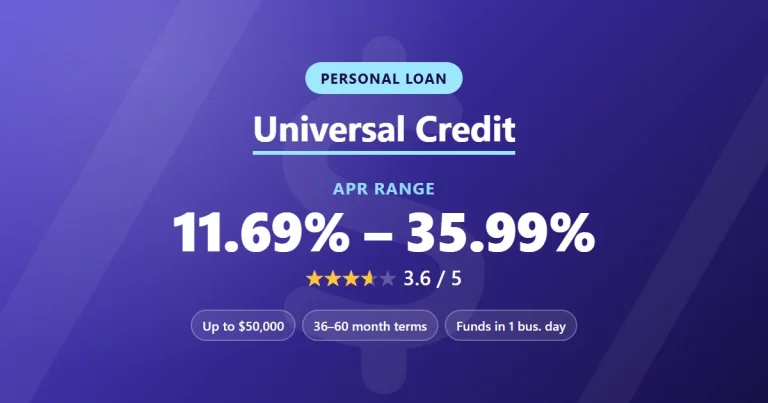
For a fair-credit borrower, the more interesting matchup is Universal Credit. Universal Credit’s APRs run from 11.69% to 35.99%, it lends up to $50,000, and its origination fee is 5.25% to 9.99%. Reach’s range starts lower and its fee can be zero, so on paper Reach is cheaper. Universal Credit, on the other hand, publishes faster funding (within one business day after verification) and offers better pricing for autopay and direct creditor payoff. The only way to know which is cheaper for you is to check both and compare the APRs on the actual offers, since APR already includes the fee.
Reach and debt relief programs
Reach’s disclosures mention National Debt Relief, noting that it isn’t a lender and that completing a debt relief program doesn’t guarantee loan eligibility. If you’re weighing a loan against debt settlement, understand the difference. A consolidation loan pays your creditors in full and gives you one fixed payment. Debt settlement negotiates balances down, often after you’ve stopped paying, which can seriously damage your credit. The Consumer Financial Protection Bureau explains how consolidation, settlement and credit counseling differ.
How the application goes
The process is fully online. You enter the amount you need (between $3,500 and $40,000) and your loan purpose, then provide basic personal, housing, employment and income details. Reach uses that to show estimated offers, including the APR, term and monthly payment, without a hard inquiry.
If you pick an offer and continue, you authorize a hard credit inquiry, which can lower your score slightly for a while. You’ll also connect or enter a bank account for funding and repayment. Reach encourages automatic electronic payments so you don’t miss due dates, though you can choose to pay by check.
Two habits will save you money here. First, compare offers by APR rather than monthly payment, because the APR already reflects the origination fee. Second, pick the shortest term you can afford. A five-year term lowers the payment but means paying interest for longer. If your income rises later, prepaying is the simplest way to cut the total cost.
Final take
Reach Financial is a decent option if you have $3,500 to $40,000 of high-rate debt, fair-to-good credit and you want a straightforward fixed loan. The 0% fee floor and modest minimum are genuine pluses. What holds it back is how little Reach tells you before you apply and the absence of any rate-reduction feature, which is why we’d prequalify with at least one competitor at the same time.
You can check your rate without a hard pull on Reach Financial’s loan page. Rates and fees are as of 2026, and offers can change.